

Tutorial 1: Cantilever Retaining Wall
Example 17.1 - Principles of Foundation Engineering. Braja Das.
Calculate the factors of safety for overturning, sliding, and bearing capacity of the cantilever wall shown in the picture.
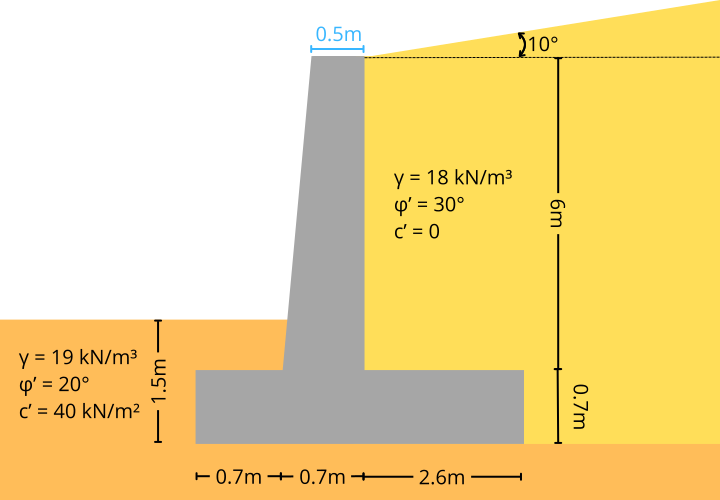
Getting started
Section titled “Getting started”- Whether you are in My workspace or in a project’s work location, go to the App.

- On the left panel, locate the Models list and click the New model button to open the menu. Then, select Retaining Wall and choose the Cantilever wall template.
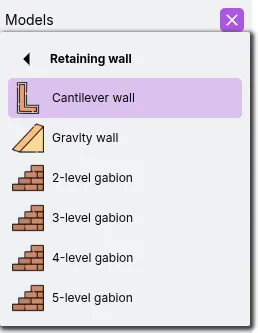
Type of analysis
Section titled “Type of analysis”- On the right panel, locate the Type of analysis section and make sure the Block by block analysis switch is set to off.

Foundation soil
Section titled “Foundation soil”- In the Foundation soil section, turn on the Include passive earth pressure (sliding only) switch. Then, enter the values for Cohesion, Friction angle, Unit weight, and Embedment depth.
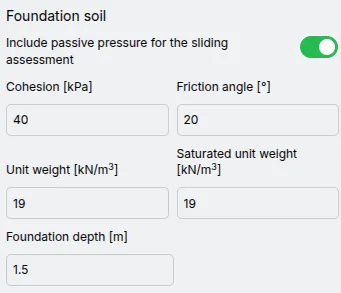
Backfill
Section titled “Backfill”- In the Backfill section, enter the values for Surface angle and Water table level.
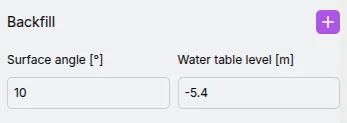
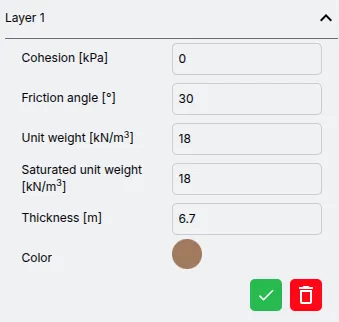
- Expand Layer 1 by clicking on it, then enter the values for Cohesion, Friction angle, Unit weight, Saturated unit weight, and Thickness. Choose a Color for the soil and click the button to save changes.
Structure
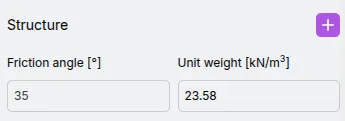
Section titled “Structure”- In the Structure section, enter the Unit weight of the structure material (e.g., concrete).
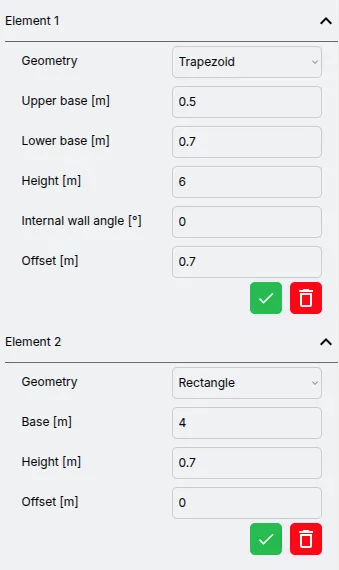
- No additional structural elements are needed. Expand Element 1 by clicking on it, select Trapezoid as the Geometry, and input the values for Upper base, Lower base, Height, Internal wall angle, and Offset. Click the button to save changes. Repeat the process for Element 2, which is a rectangle.
Results
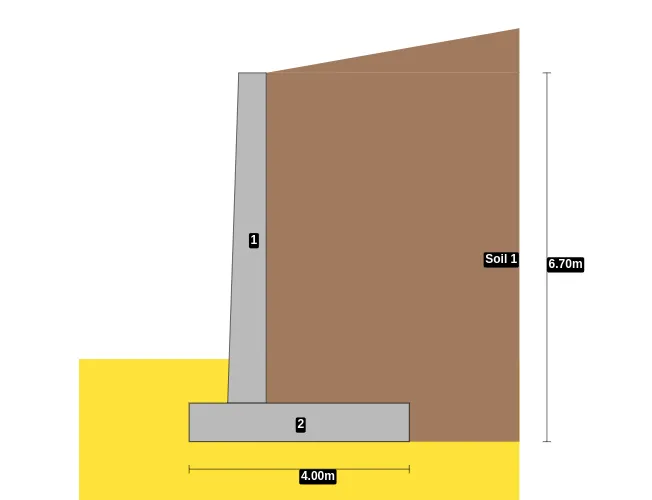
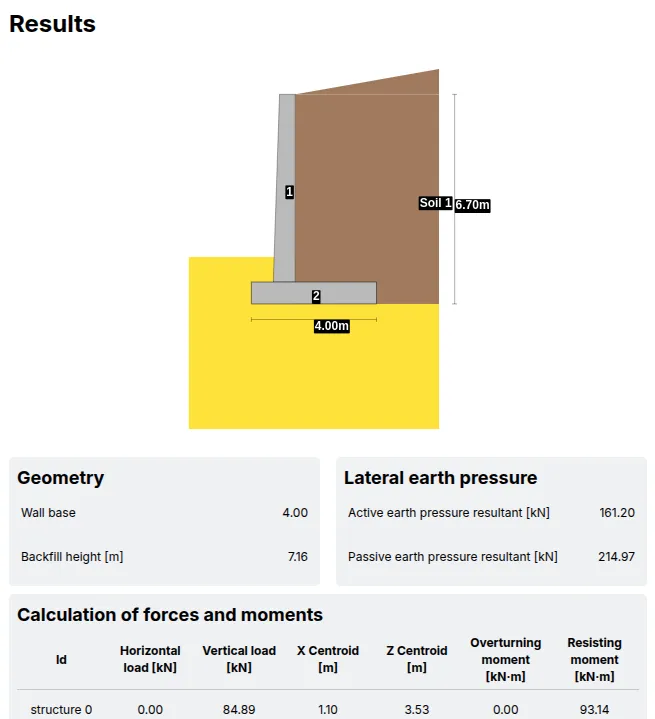
Section titled “Results”- Once all parameters are set, verify that the structure appears as expected.
- Click the icon at the top of the right panel to run the model.

- The Results tab will be enabled and will display the analysis results.
Verification
Section titled “Verification”Below is a summary of key variables and their expected versus obtained values.
| Variable | Expected value | Obtained value |
|---|---|---|
| Active earth pressure | 161.2 kN | 161.20 kN |
| Passive earth pressure | 215 kN | 214.97 kN |
| Factor of safety for overturning | 2.98 | 2.98 |
| Factor of safety for sliding | 2.73 | 2.73 |
| Factor of safety for bearing capacity | 3.0 | 2.93 |
The difference in the Factor of safety for bearing capacity is due to the fact that the book calculates using instead of , which is not recommended according to its own criterion expressed in Chapter 6.11.
References
Section titled “References”- Das, B. M., & Sivakugan, N. (2018). Principles of Foundation Engineering.